The display above is the plugin's own drawing code, running here in the page.
The first minute
| Do | What happens |
|---|---|
| Start with the drive low and one model chosen | Triode is the softest, Pentode the hardest, Vari-Mu gives way as you push, Iron leans on the lows. Pick one and stay there while you learn the range; the valve in the socket changes with your choice. |
| Raise the drive until the curve visibly bends | That bend is the saturation. The VALVE needle reaches zero at the same point, the harmonic bars fill in, and the valve in the socket glows brighter: four views of one event. |
| Use DELTA to hear only what you added | It plays the difference between input and output: the harmonics alone, without the signal underneath. |
| Match levels before you judge | Saturation raises perceived loudness. Leave AUTO G on, then decide whether you like it. |
Reading the screen
The curve maps input to output like the compressor's does, but here the bend is the sound rather than the control. The bars are the harmonics that bend produces. The VALVE meter is the same story as a needle.
| What you see | What it means |
|---|---|
| The straight part | Small signals pass at unity, every model. Quiet passages are untouched. |
| The bend | Where saturation starts. Deeper bend, more harmonics. Zero on the VALVE meter. |
| Even bars | Second, fourth: the warm ones. Triode leans here, and BIAS pushes further. |
| Odd bars | Third, fifth: the firm ones. Pentode and Iron lean here. |
| The glow | Follows the measured harmonic energy. Pentode's plate reddens when driven hard, Vari-Mu's pair settles as it saturates. |
| DELTA | The added harmonics on their own, with the dry signal removed. |
The controls
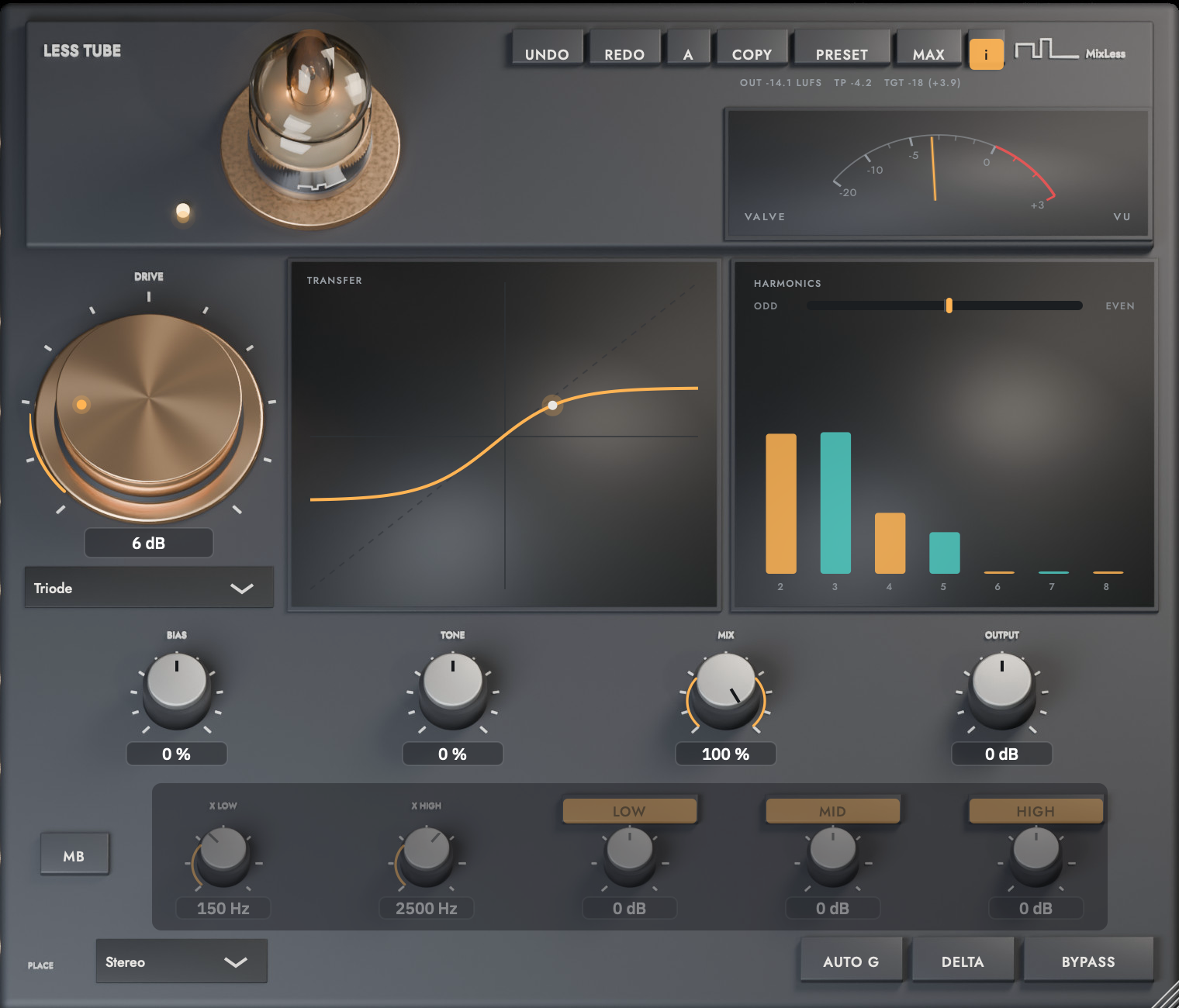
| Control | What it does |
|---|---|
| MODEL | Triode, Pentode, Vari-Mu or Iron. They differ in which harmonics they favour and how they give way, not in loudness. |
| DRIVE | How hard the signal hits the valve. The big copper knob; the VALVE meter reads the result. |
| BIAS | Trades even harmonics against odd. Off centre makes second harmonic, the warm one. |
| TONE | Chooses where it saturates: negative drives the lows into the curve, positive the highs. The output is not tilted. |
| MIX | Blend of driven and clean, for parallel saturation. Time aligned. |
| OUTPUT | Trim after the valve. |
| PLACE | What the valve touches: stereo, mid, side, left or right. |
| MB | Splits into three regions with their own drive offsets. Every region carries the same latency, so the bands stay aligned. |
| DELTA | Monitors the difference only. |
How to work with it
Saturation is a small effect used often, not a big one used once. A little on several channels adds up to something a lot on the master cannot do.