The display above is the plugin's own drawing code, running here in the page.
The first minute
| Do | What happens |
|---|---|
| Put it last on the master | After everything else. It measures and passes the audio through untouched. |
| Play the loudest section, not the intro | Integrated loudness needs material. Twenty seconds of the busiest part tells you more than a full pass of a quiet one. |
| Read integrated first, then true peak | Integrated is where your master sits; true peak is the measure lossy encoders overshoot on. |
| Check correlation on wide material | Near plus one is mono compatible; near minus one collapses when someone plays it in mono. |
Reading the screen
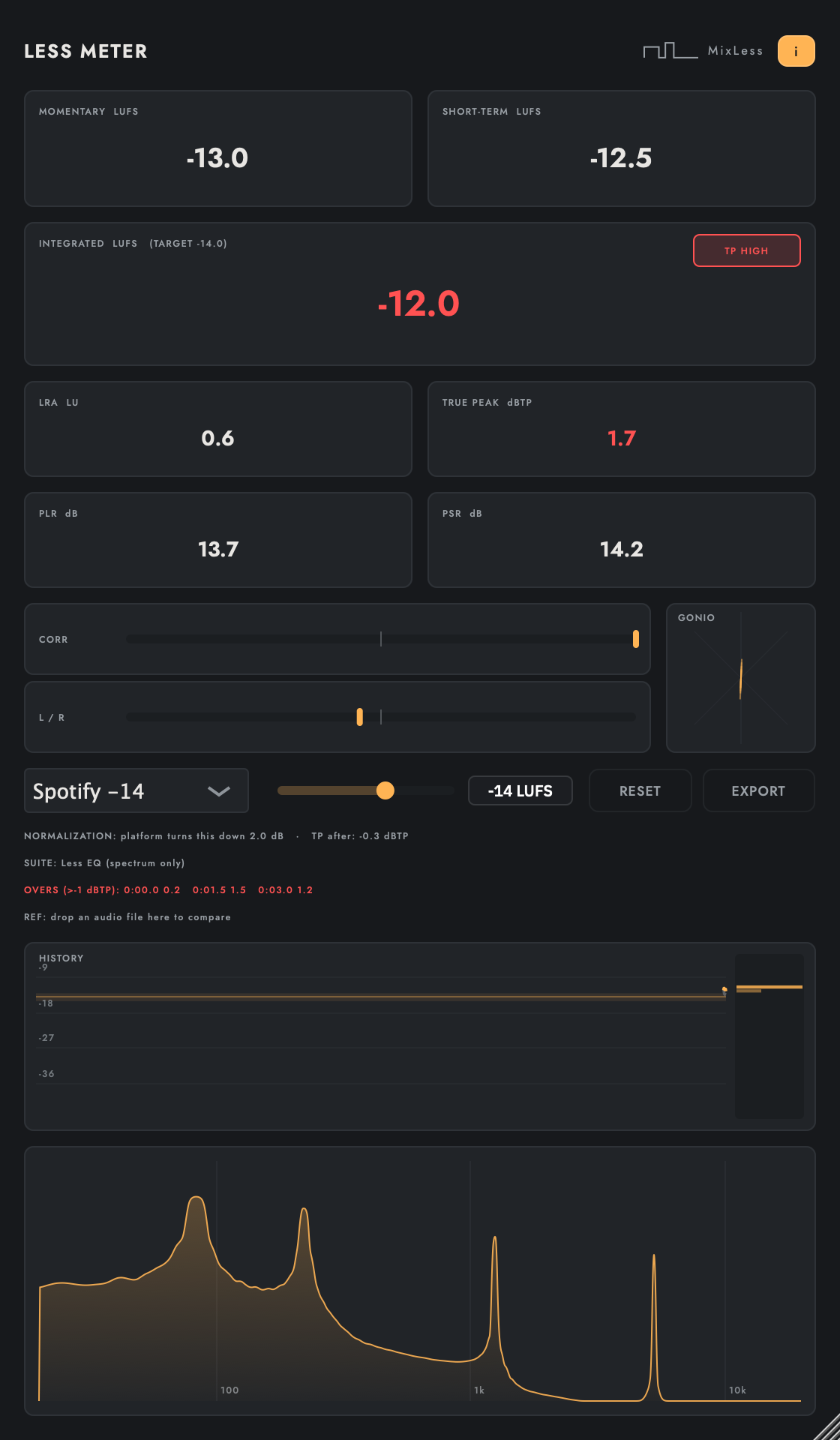
Loudness is measured the way streaming services measure it, so the number here is the number they will read. True peak is measured between samples, which is exactly where a sample peak meter lies to you.
| What you see | What it means |
|---|---|
| INTEGRATED | Loudness over the whole pass. The one number a streaming service acts on. |
| SHORT, MOMENTARY | Three seconds and four hundred milliseconds. These move; integrated does not. |
| TRUE PEAK | The peak between samples, not just on them. This is where a sample peak meter underreads. |
| RANGE | How far loudness travels across the pass. A small number means a flat master. |
| CORRELATION | Plus one is mono, zero is wide, minus one cancels in mono. |
| READY | Integrated within 1 LU of the target you chose and true peak under your ceiling. It checks your numbers against your target; it is not a verdict on the mix or a promise about any platform. |
The controls
| Control | What it does |
|---|---|
| TARGET | The loudness you are aiming for. The readout shows the distance to it. |
| CEILING | The true peak ceiling you want to respect. |
| RESET | Clears integrated, range and the peak holds. |
| REFERENCE | Hold a reference track's numbers beside yours and compare without switching. |
How to work with it
Meter last, always. Anything after the meter changes what the listener hears but not what you measured, and that gap is where masters go wrong.